Executive Summary
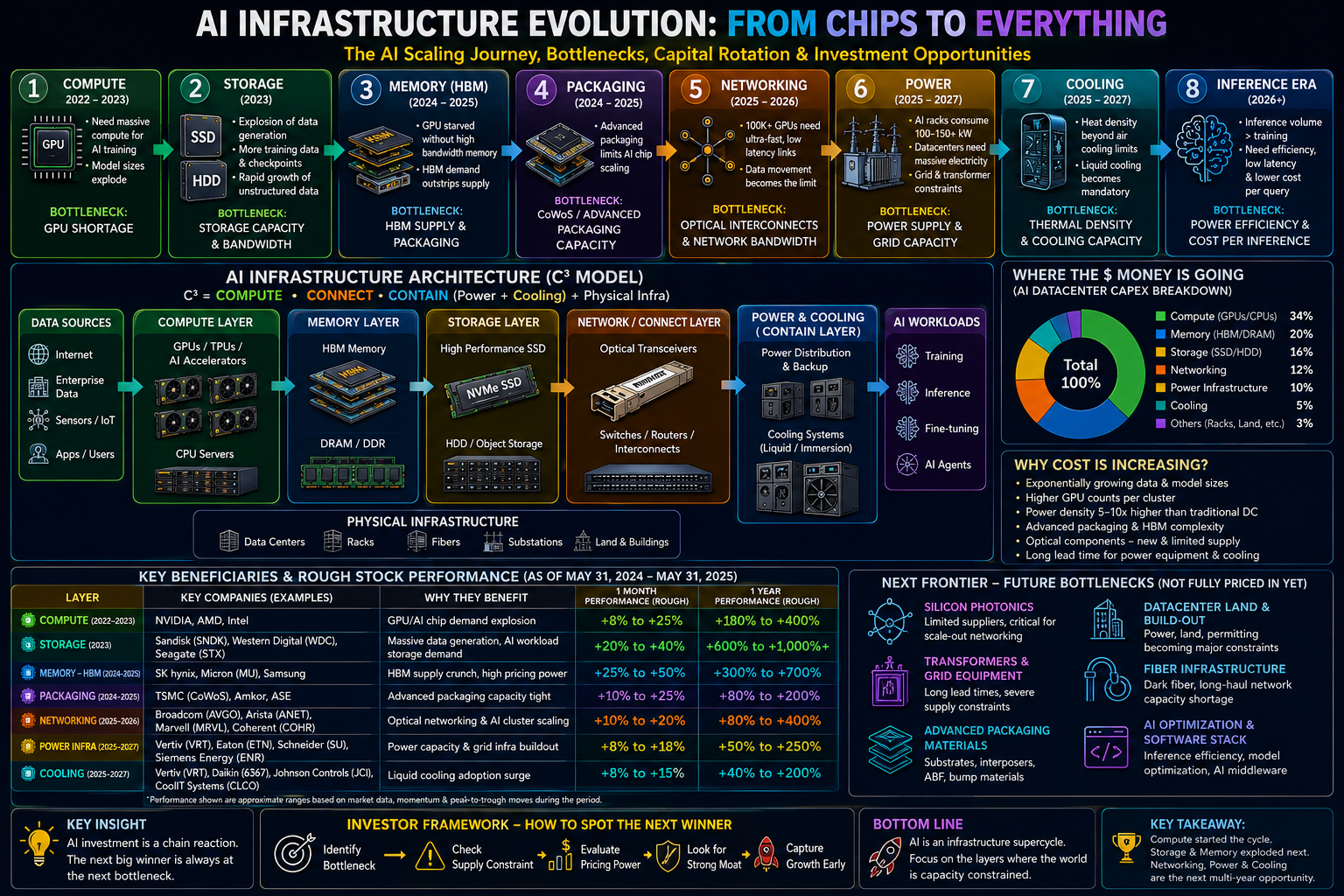
The AI boom is not just a software story. It is a chain reaction across:
- semiconductors
- storage
- memory
- networking
- power systems
- cooling
- datacenter infrastructure
- manufacturing capacity
Every phase of AI scaling exposes a new bottleneck. Capital rotates toward:
- the most constrained layer,
- the highest pricing power,
- the hardest supply chain to expand.
This explains why the market moved:
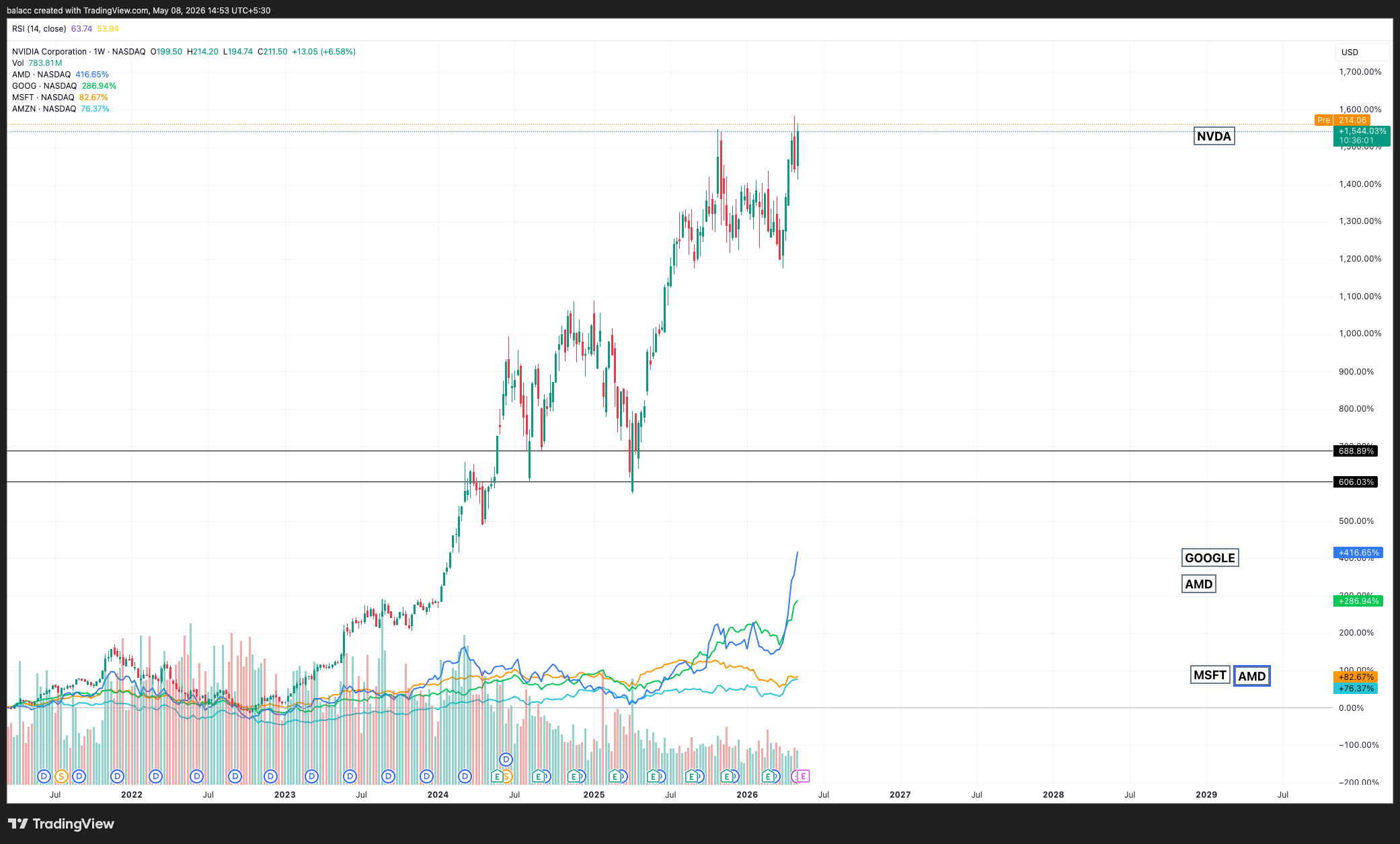
- GPUs → 2023
- HBM memory → 2024–2025
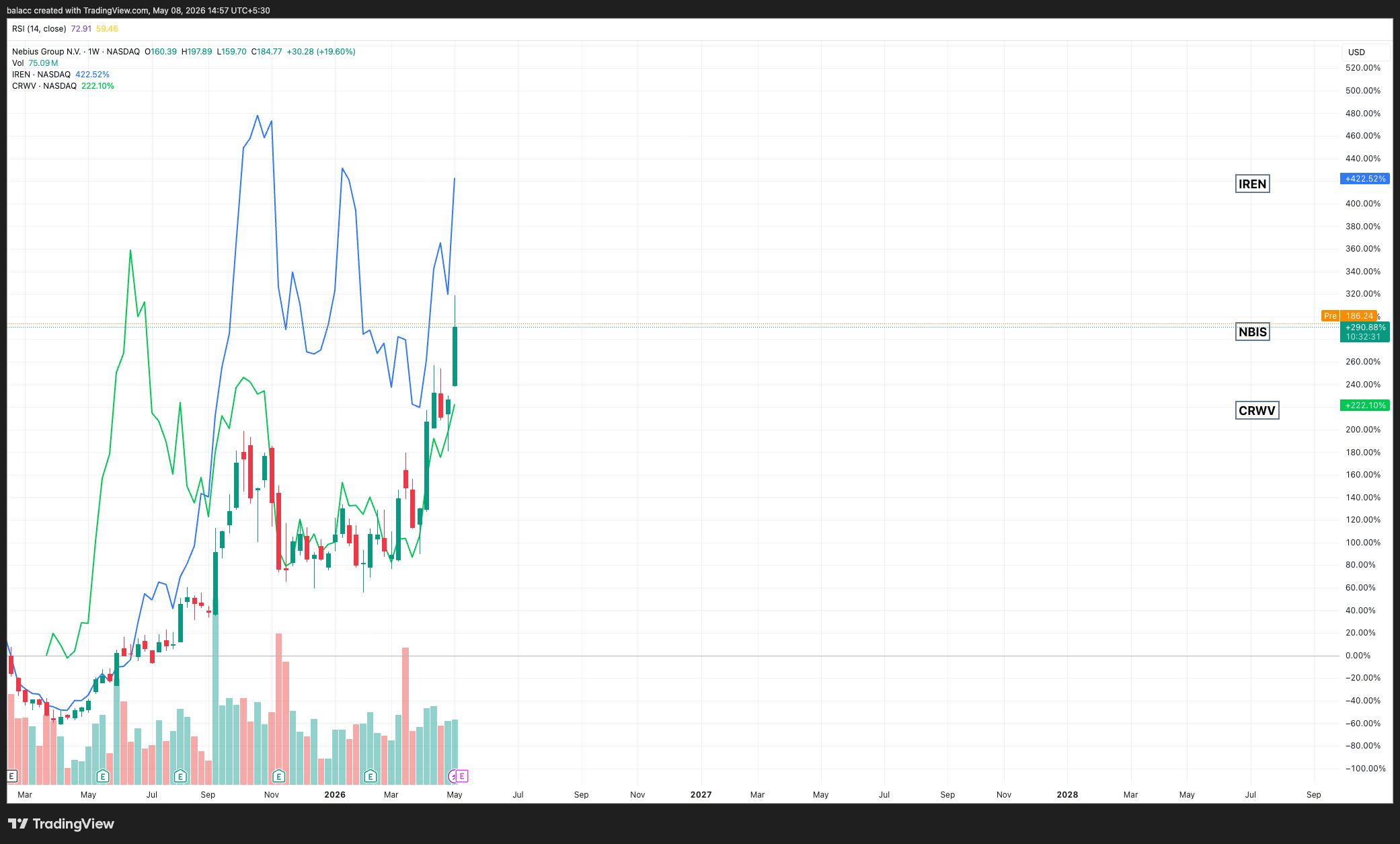
- CPUs / networking / power / cooling → emerging now
The key insight:
AI investing is fundamentally "bottleneck investing."
Phase 1: Compute Bottleneck (2022–2023)"AI needs massive compute"
What triggered the boom?
The launch of:
- ChatGPT
- large language models
- generative AI
created explosive demand for AI training infrastructure. Training models required:
- parallel computing
- tensor acceleration
- GPU clusters
Traditional CPUs were insufficient.
Why GPUs won
GPUs were ideal because they could:
- process massive parallel workloads
- train neural networks efficiently
- scale across thousands of chips
This created a compute bottleneck.
Key winners
GPU leaders
Semiconductor manufacturing
Equipment suppliers
Why NVIDIA dominated
NVIDIA had:
- CUDA ecosystem dominance
- software moat
- AI-first architecture
- early hyperscaler relationships
The market realized:
AI compute = NVIDIA GPUs
This caused historic demand spikes.
Bottlenecks during this phase
1. GPU supply shortage
Demand exceeded production capacity.
2. Foundry capacity shortage
Advanced nodes were limited.
3. Advanced packaging shortage
Especially:
- CoWoS packaging
- HBM integration capacity
Result
GPU prices surged. Datacenter capex exploded. AI infrastructure became the dominant tech investment theme.
Phase 2: Storage Bottleneck (2023–2024)"AI training consumes enormous storage"
After GPUs became the focus, the next issue emerged:
AI models needed massive amounts of data storage and ultra-fast retrieval.
AI training required:
- huge datasets
- checkpoints
- embeddings
- vector databases
- continuous high-speed data streaming
This suddenly increased demand for:
- enterprise SSDs
- NAND flash
- hyperscale storage systems
The bottleneck shifted to:
storage capacity + storage bandwidth.
Why storage stocks surged:
- AI workloads exploded
- hyperscalers rapidly expanded storage infra
- NAND supply remained tight
- enterprise SSD demand accelerated
Major beneficiaries:
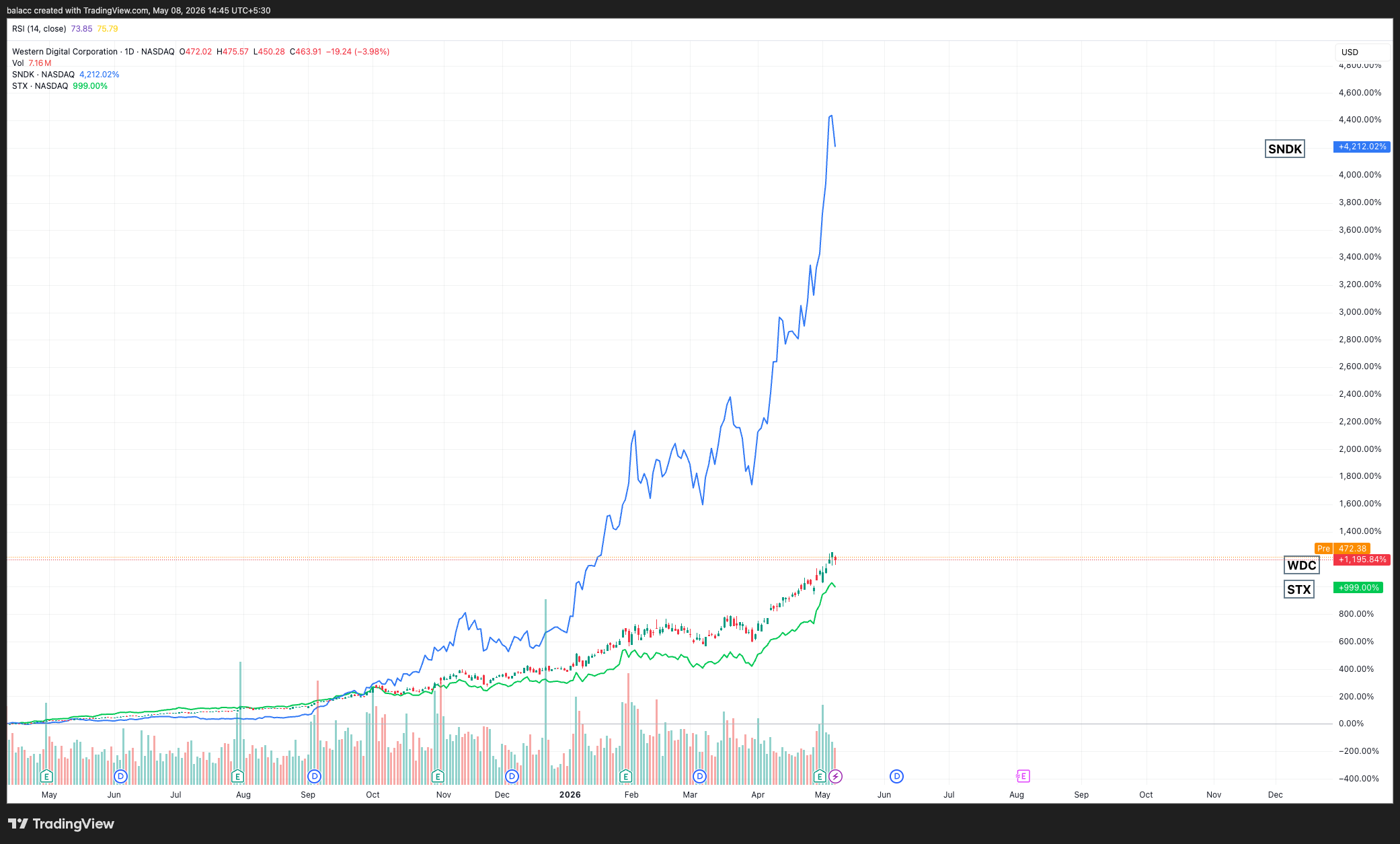
- Western Digital (1000%+) 🚀🚀
- Seagate (1000%+) 🚀🚀
- SanDisk (2000%+) 🚀🚀🚀
- Micron Technology
- Samsung Electronics Semiconductor
Key insight:
AI is fundamentally a data explosion cycle, not just a GPU cycle.
Phase 3: Memory Bottleneck (2024–2025)"Compute alone is not enough"
The problem discovered
As AI models became larger:
- parameter counts exploded
- context windows expanded
- inference workloads increased
The limitation shifted from:
compute power
to:
memory bandwidth.
GPUs became starved for data.
Why HBM became critical
HBM (High Bandwidth Memory):
- sits extremely close to GPU
- enables massive data throughput
- reduces latency
- improves AI training speed
Without HBM:
- advanced GPUs lose efficiency
- AI scaling slows dramatically
Industry realization
The real AI accelerator stack became: GPU + HBM + packaging — not just GPU alone.
Key winners
Memory leaders
- SK hynix
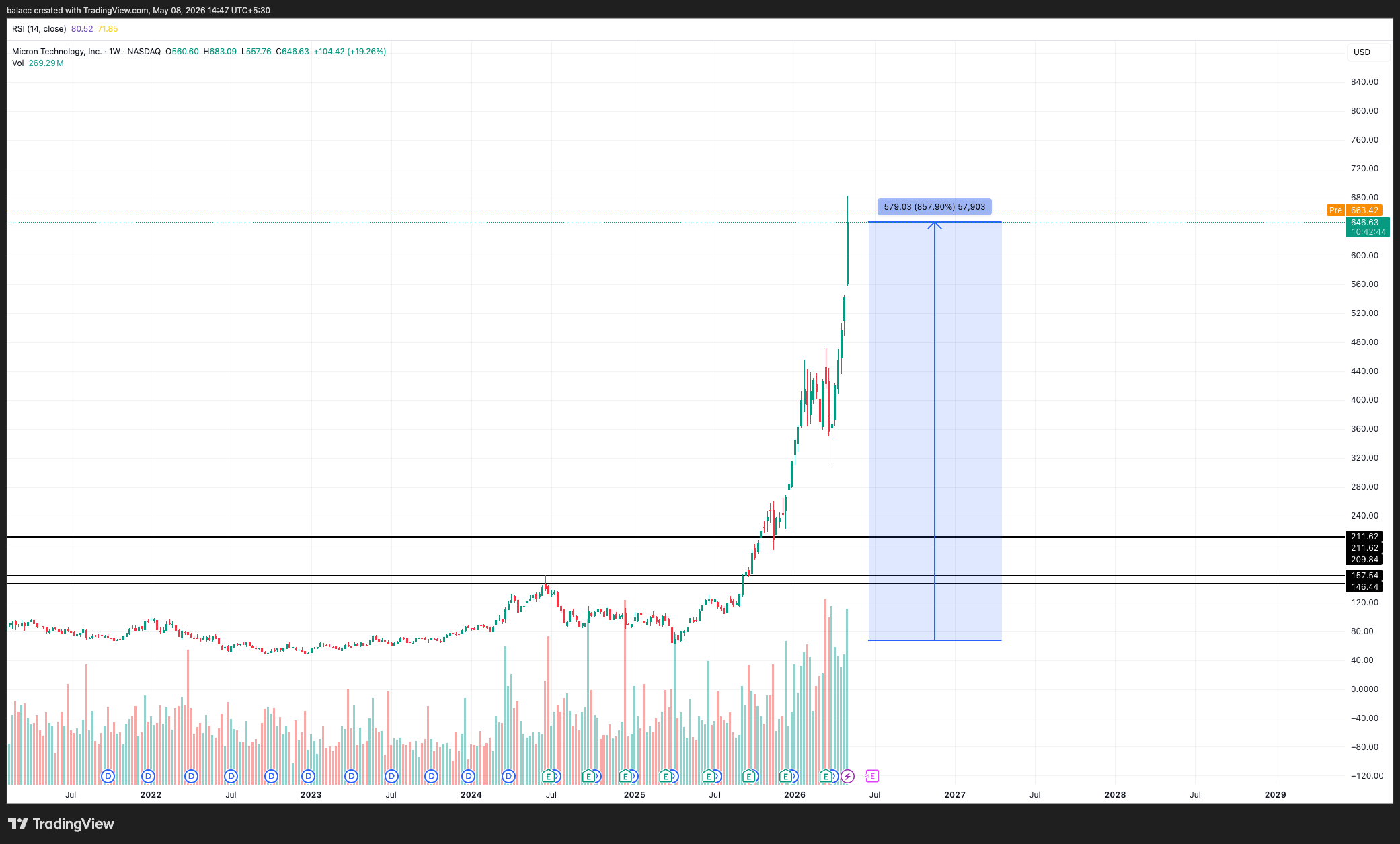
- Micron Technology (500%+) 🚀
- Samsung Electronics
Why memory stocks exploded
HBM had:
- limited suppliers
- complex manufacturing
- long qualification cycles
- high margins
- severe shortages
Supply could not scale fast enough. This created: pricing power, margin expansion, multi-year demand visibility.
Hidden bottleneck: Packaging
Even if HBM supply improved, advanced packaging remained constrained. Critical technologies:
- CoWoS
- 2.5D packaging
- 3D stacking
became essential.
Industry lesson
AI scaling is a systems problem, not just a chip problem.
Phase 4: Networking Bottleneck (Emerging Now)"How do 100,000 GPUs communicate?"
Why networking became critical
AI clusters evolved from single servers to hyperscale GPU fabrics. Large AI systems require:
- constant synchronization
- ultra-fast communication
- low latency networking
The bottleneck shifted to:
interconnect bandwidth.
The core problem
Moving data between GPUs consumes:
- time
- power
- heat
At massive scale, communication itself becomes expensive.
Current industry focus
Optical networking
The next major transition is toward:
- silicon photonics
- optical interconnects
- co-packaged optics
because copper networking is approaching physical limits.
Why optics matter
Optics offer:
- lower power consumption
- higher bandwidth
- lower latency
- better scaling across large clusters
Companies gaining attention
Networking / optics
- Broadcom 🚀
- Arista Networks
- Marvell Technology 🚀🚀
- Coherent Corp
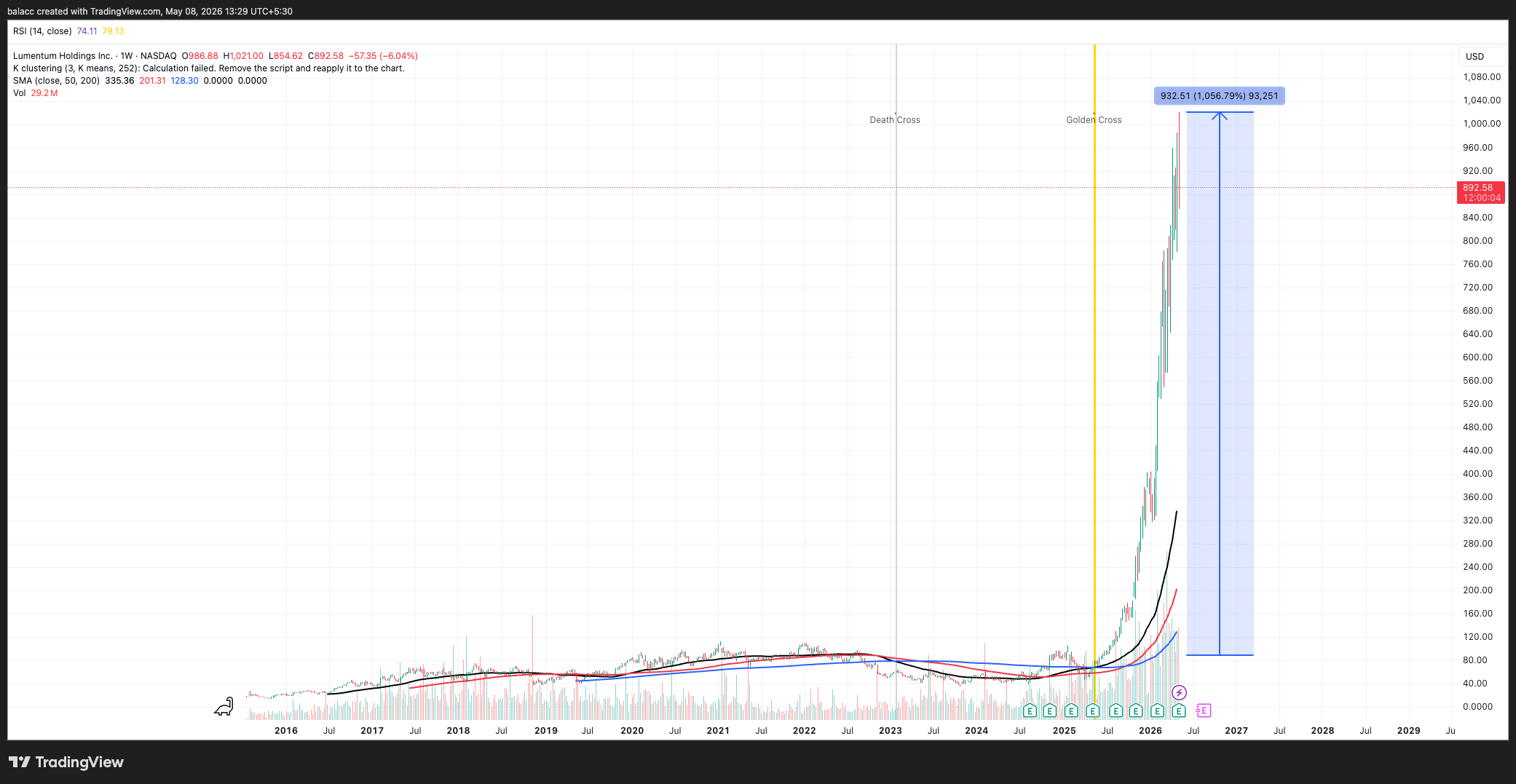
- Lumentum Holdings (2000%+) 🚀🚀🚀
- Ciena (1000%+) 🚀🚀
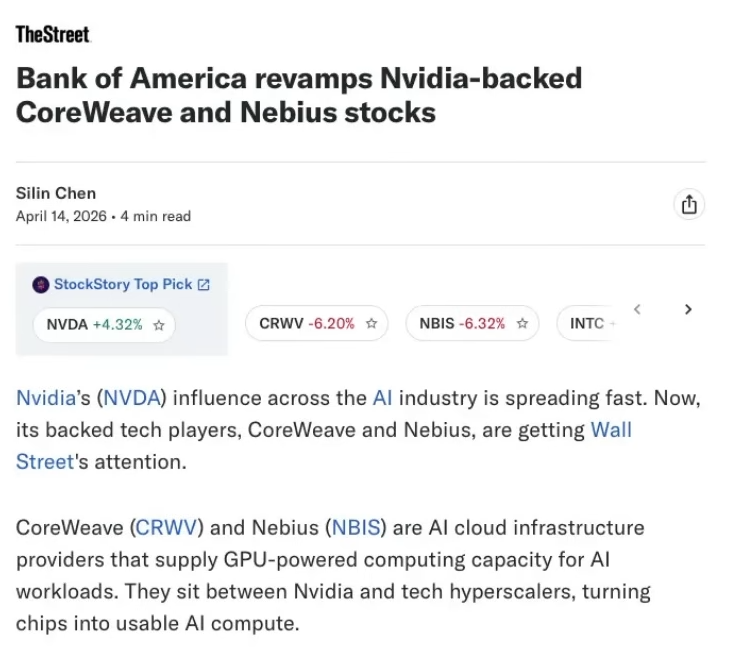
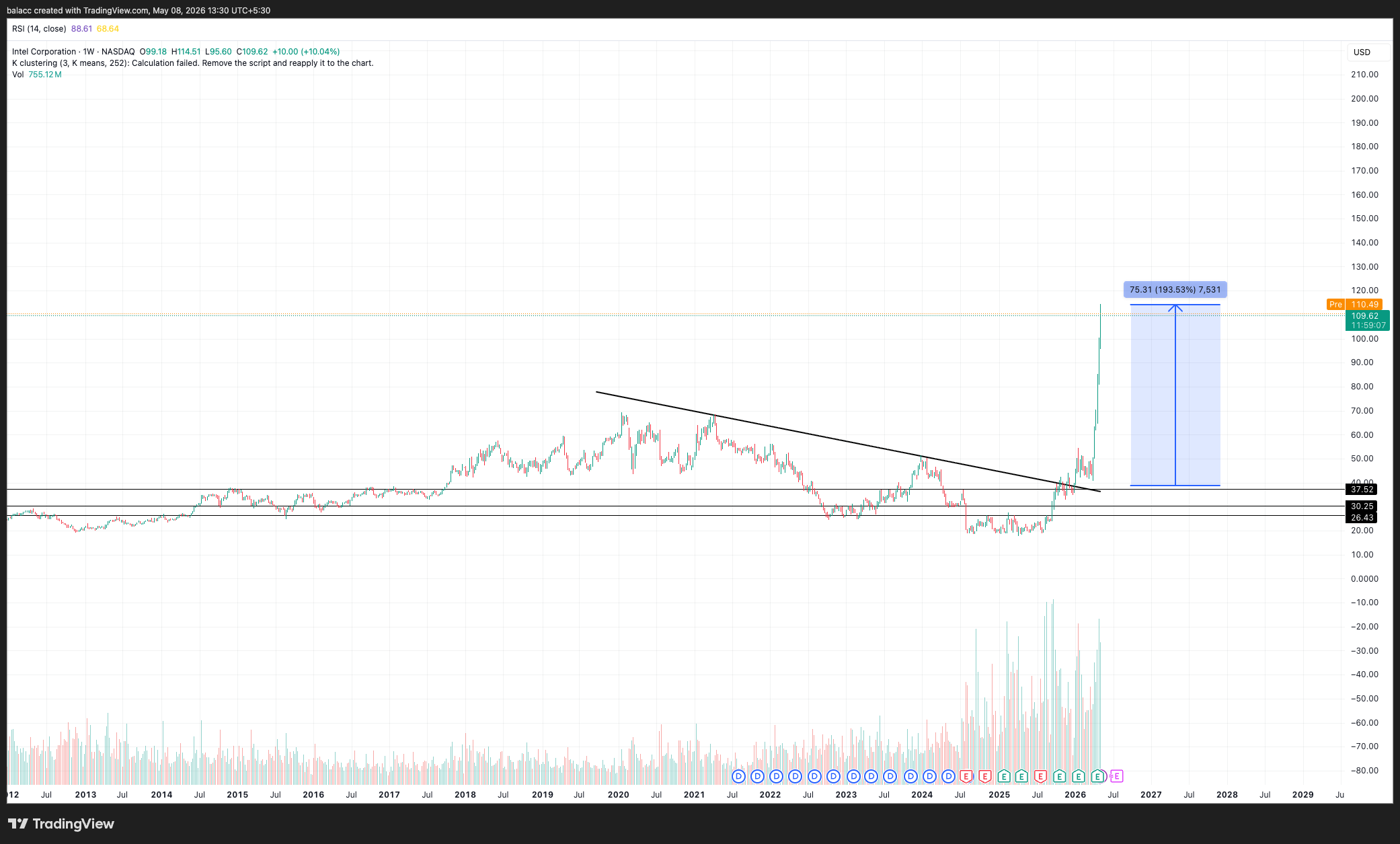
- Intel
SMH ETF covers some of them in this layer + chip layer.
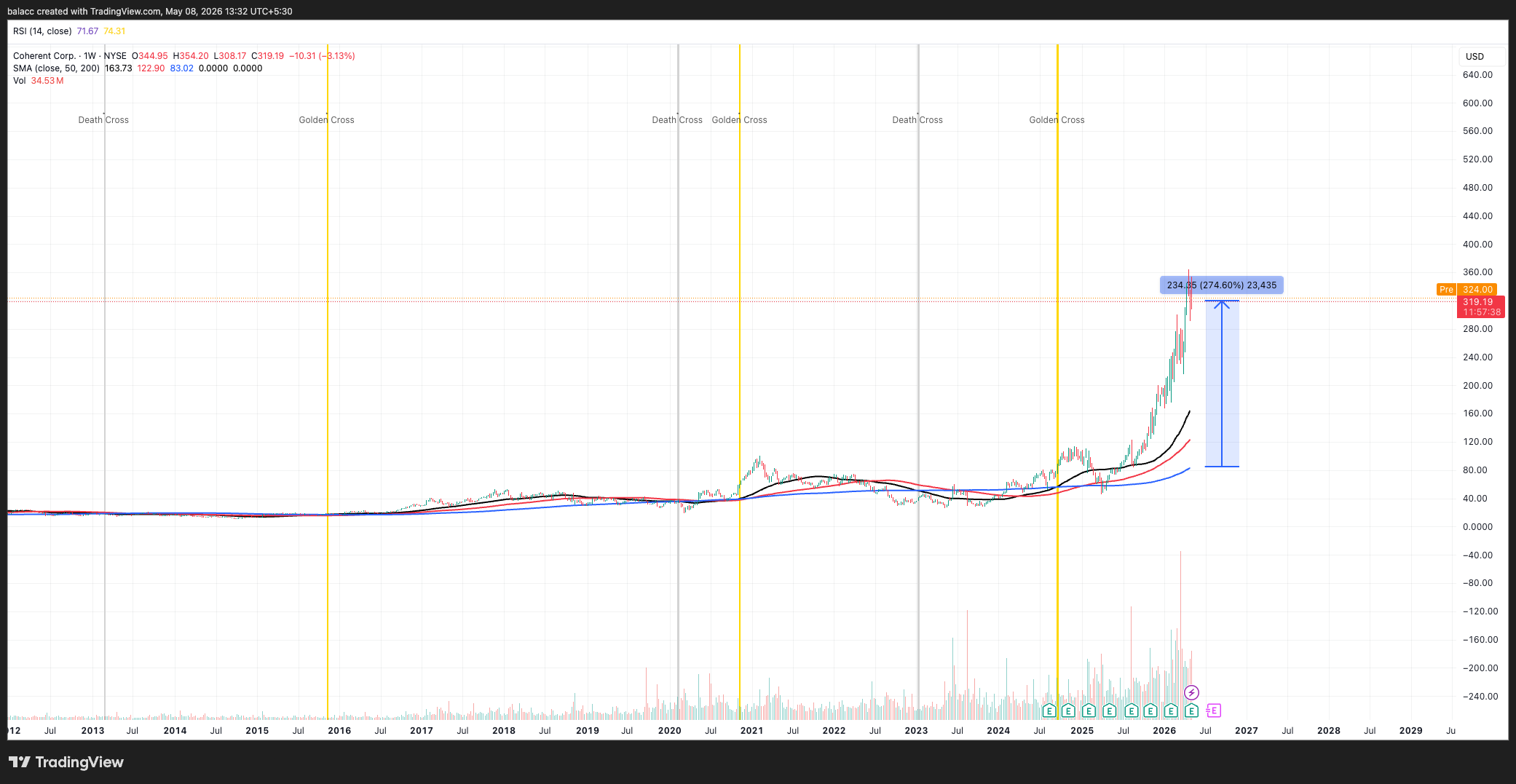
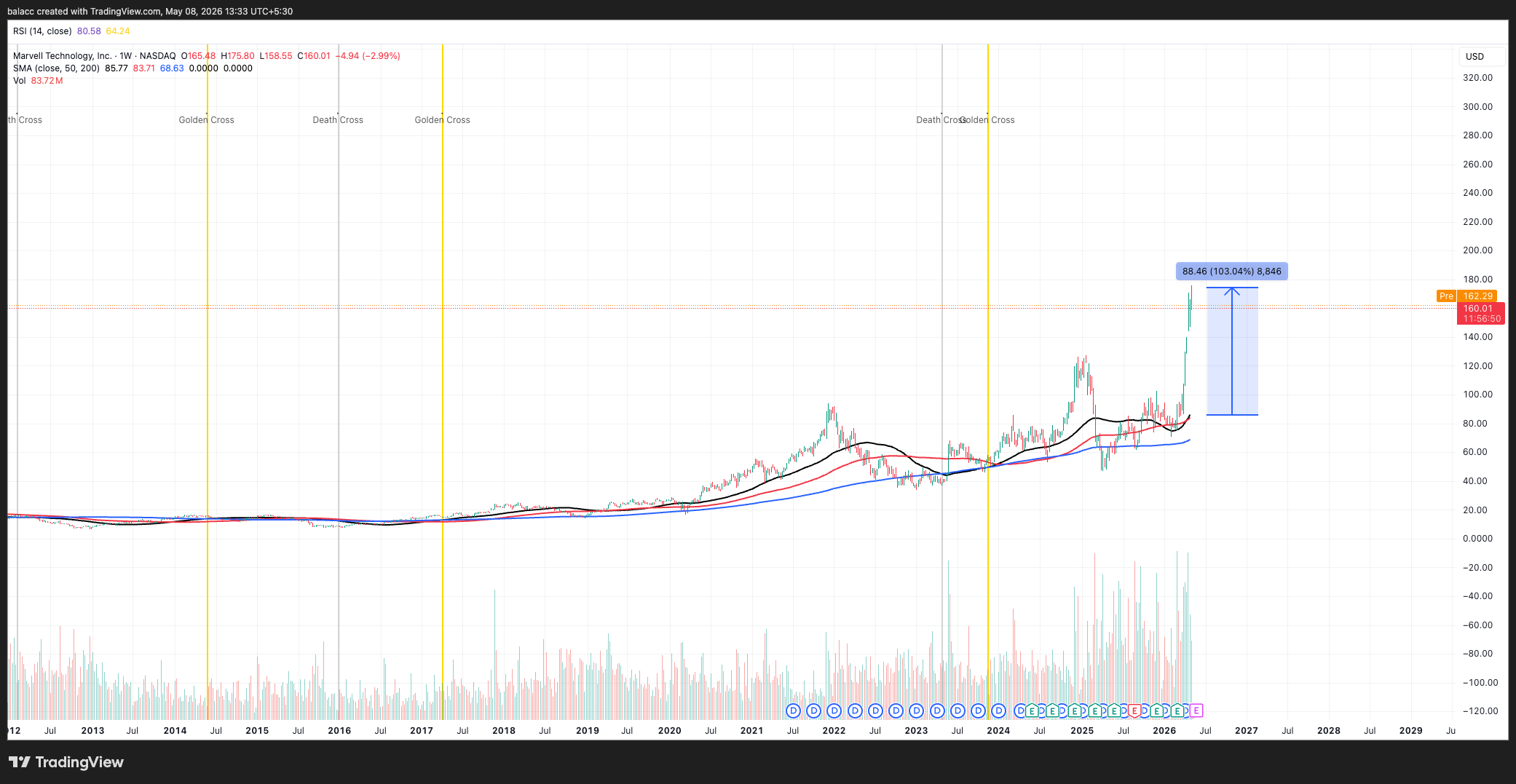
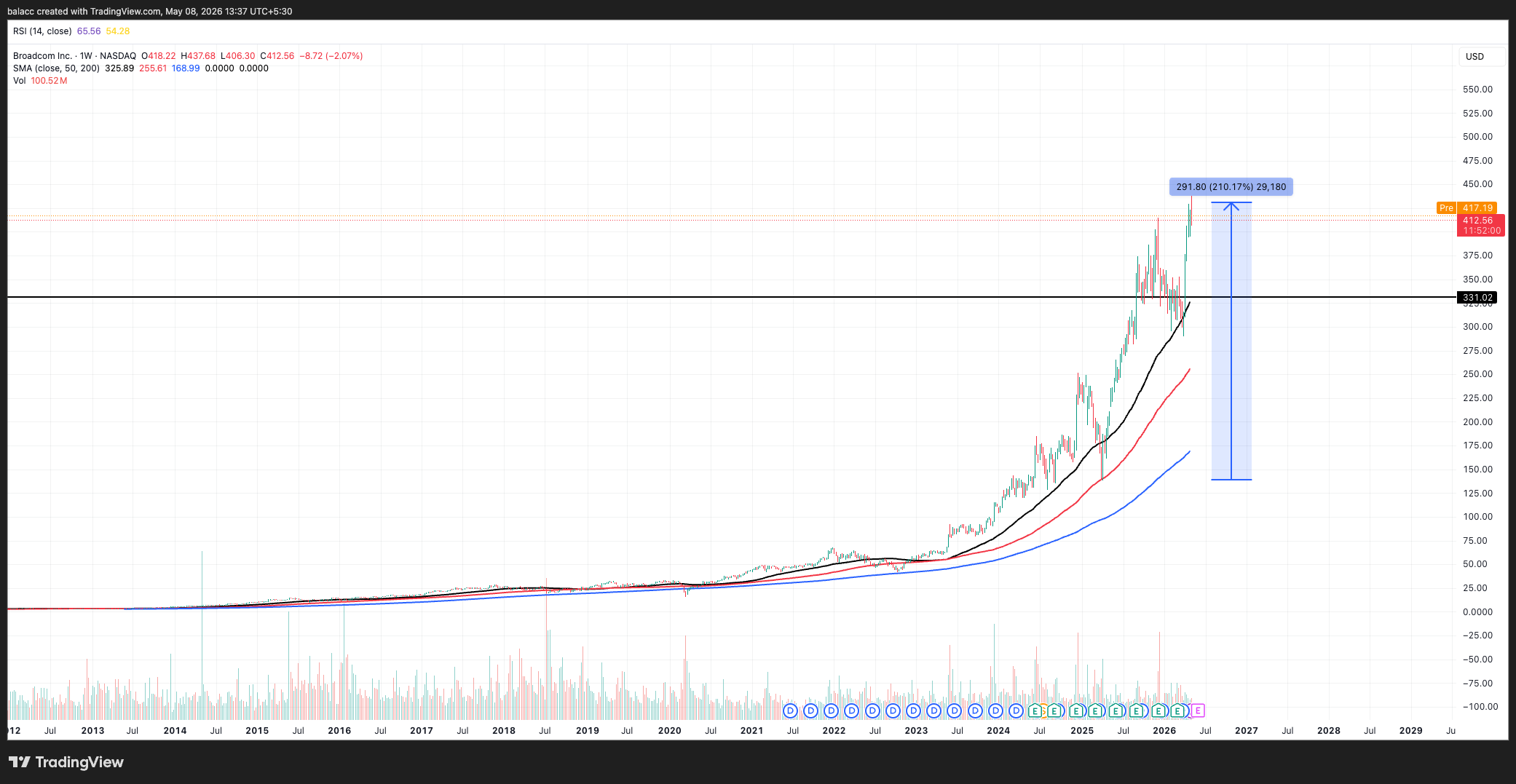
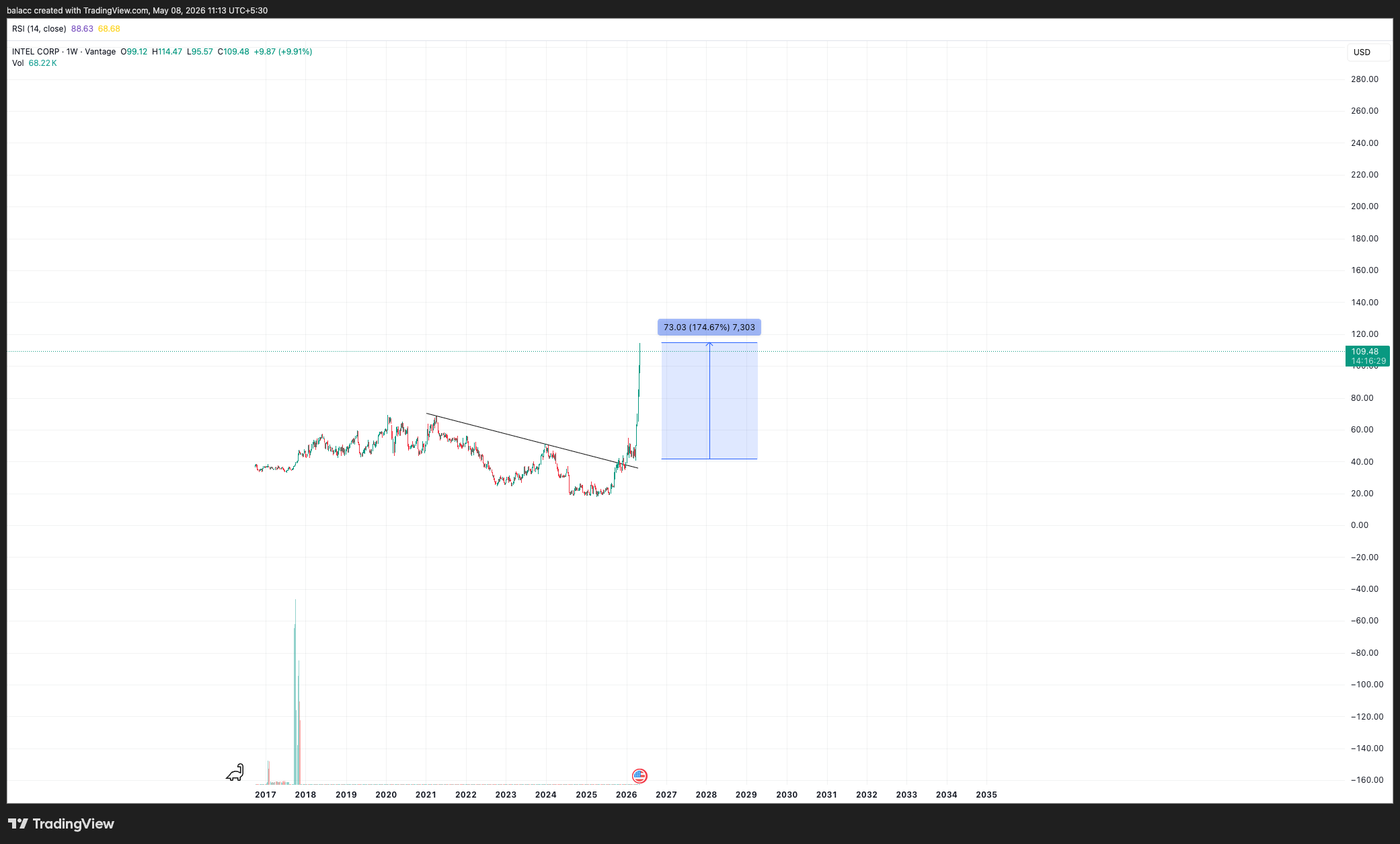
| Segment | Current Stage | Potential Re-rating | Companies |
|---|---|---|---|
| Optical Networking | Early-middle innings | Strong | Ciena, Nokia, Juniper |
| Optical Components | Corning, Coherent | ||
| Silicon Photonics | Early adoption | Very high | Coherent, Lumentum, Intel |
| AI switching fabrics | Rapid hyperscaler demand | Strong | Broadcom, Cisco, Arista, Networks, NVIDIA Spectrum-X |
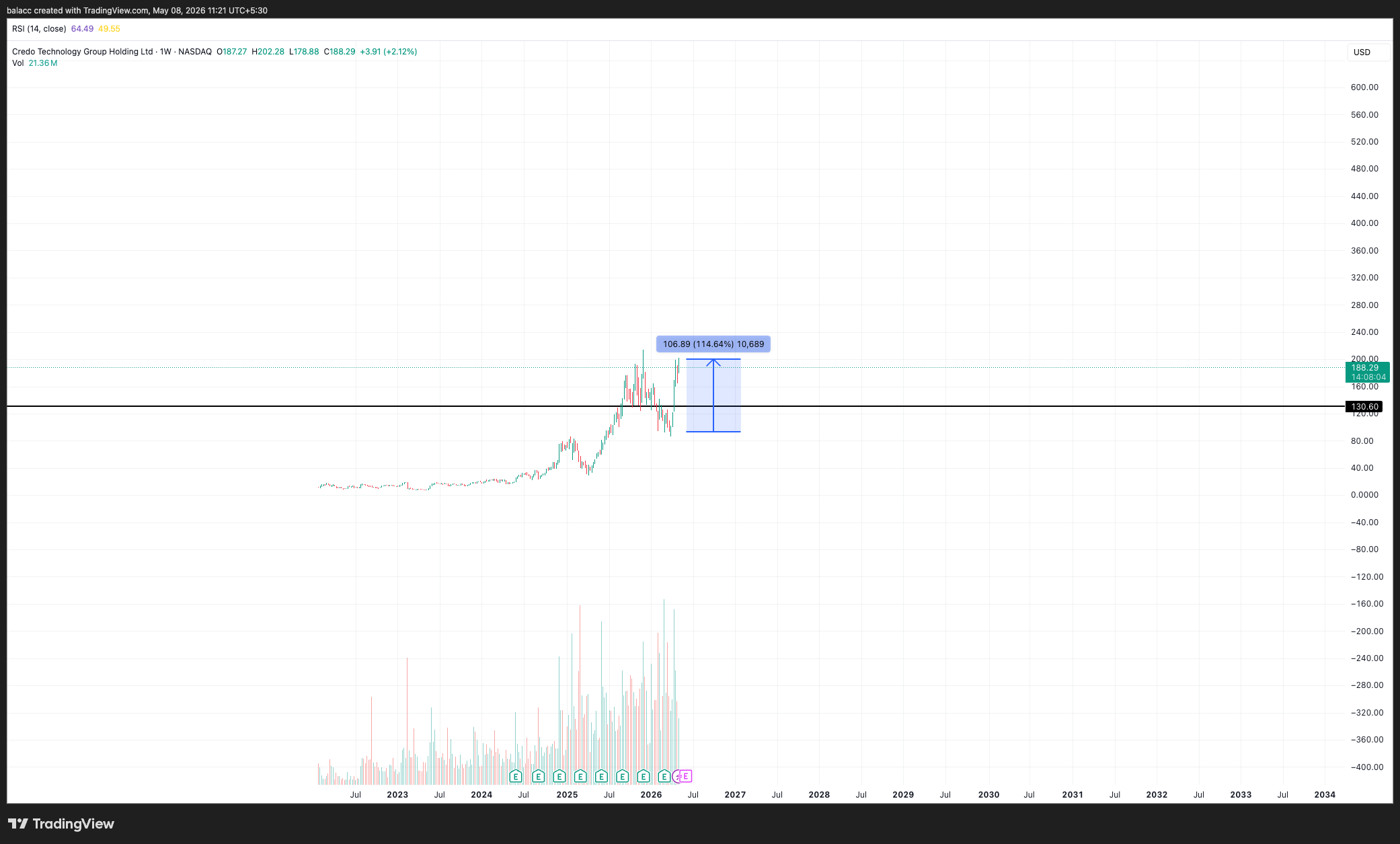
| AI Interconnect Startups | Ayar Labs, Astera Labs, Credo |
Why this could be the next "HBM moment"
Characteristics are similar:
- rapidly rising demand
- supply complexity
- difficult manufacturing
- high technical barriers
- hyperscaler dependency
This often creates:
- pricing power
- multi-year expansion cycles
Phase 5: Power Bottleneck (Current + Future)"AI runs on electricity"
Biggest industry realization
AI datacenters consume enormous energy. Earlier datacenter racks: 5–15 kW. Modern AI racks: 100–150+ kW. Future AI systems may require gigawatt-scale campuses.
New constraints emerging
Hyperscalers now face:
- grid limitations
- transformer shortages
- substation constraints
- transmission bottlenecks
This changes AI from a:
semiconductor problem
to a:
national infrastructure problem.
Where spending is increasing
Electrical infrastructure
Demand rising for:
- transformers
- switchgear
- power management systems
- grid equipment
- backup systems
Key beneficiaries
Important insight
Power infrastructure scales slower than semiconductors. This creates:
- persistent shortages
- long lead times
- pricing power
Phase 6: Cooling Bottleneck"AI generates enormous heat"
The issue
Dense AI clusters produce:
- extreme thermal loads
- higher rack temperatures
- cooling inefficiencies
Traditional air cooling is becoming inadequate.
Industry shift
Datacenters are moving toward:
- liquid cooling
- immersion cooling
- direct-to-chip cooling
Why cooling becomes critical
Without proper cooling:
- GPU efficiency drops
- hardware lifespan decreases
- power consumption rises
Cooling becomes essential infrastructure.
Why investors care
This creates new demand for:
- thermal systems
- industrial HVAC
- liquid cooling ecosystems
This area remains relatively under-owned compared to semiconductors.
Phase 6 (Parallel): Agentic / Orchestration Bottleneck (2026+)"Running millions of AI agents efficiently"
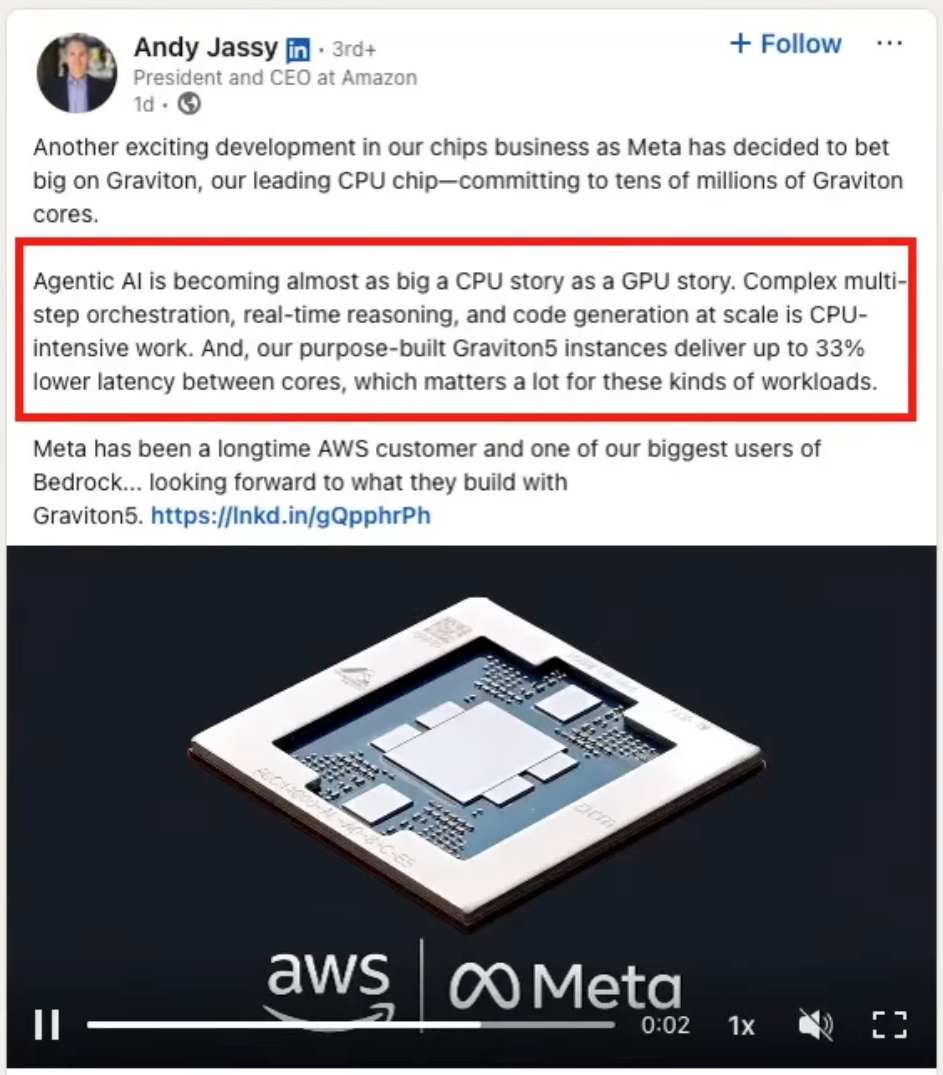
AWS × Meta Graviton AI partnership announcement
After solving:
- compute (GPU)
- storage
- memory (HBM)
- networking
- power & cooling
a new constraint is emerging:
how to manage and scale AI systems in real-world usage.
What changed?
AI is moving from model training to continuous execution (agents, copilots, workflows). Instead of one model run, systems now involve:
- multi-step reasoning
- tool/API calls
- memory retrieval
- parallel agents
- real-time decision loops
The new bottleneck
Not GPU. Not memory. It is:
orchestration compute (CPU + system layer)
Why CPU becomes critical again
These workloads are:
- sequential (not massively parallel)
- logic-heavy
- latency-sensitive
- coordination-heavy
Handled mainly by CPUs, system memory (DDR), and backend infrastructure.
Where pressure builds
1. Agent concurrency
Thousands to millions of agents running simultaneously.
2. Context management
Frequent reads/writes from memory systems.
3. Tool execution
API calls, DB queries, external integrations.
4. Scheduling & coordination
Managing workflows across systems.
Resulting bottlenecks
- CPU core availability
- memory bandwidth (DDR, not HBM)
- system-level latency
- backend orchestration efficiency
Key beneficiaries
Compute / CPU
Cloud / orchestration layer
Why this matters
The next wave of AI demand is not:
"train bigger models"
It is:
"run AI continuously at scale"
This shifts optimization toward: cost per request, latency, efficiency, orchestration.
Key insight
GPUs power intelligence.
CPUs coordinate intelligence.
As AI moves into real-world deployment, coordination becomes the bottleneck.
Investor takeaway
This phase may not create a sudden spike like GPUs or HBM. But it can drive:
- sustained demand for high-performance CPUs
- growth in backend infrastructure
- expansion of AI orchestration platforms
If earlier phases were about building intelligence, this phase is about operating intelligence at scale.
Phase 7: Inference Era (Future)"Inference may become larger than training"
What changes?
Today's AI boom is training-heavy. Future AI demand may come primarily from:
- billions of inference requests
- AI assistants
- enterprise AI agents
- AI search
- edge AI devices
New optimization goals
Focus shifts from raw FLOPS toward:
- efficiency
- latency
- cost per query
- power efficiency
Likely future winners
Custom AI chips
- ASICs
- inference accelerators
- edge AI processors
AI devices
- AI PCs
- AI smartphones
- on-device inference
Full Chain Reaction of AI Infrastructure
- AI models grow larger
- Need more GPUs
- GPU shortage emerges
- Need more HBM memory
- Memory shortage emerges
- Packaging capacity becomes constrained
- GPU clusters become enormous
- Networking bandwidth becomes bottleneck
- Power consumption explodes
- Cooling infrastructure becomes critical
- Inference efficiency becomes dominant
The AI Infrastructure Stack
| Layer | Bottleneck | Major Cost Driver | Key Companies |
|---|---|---|---|
| Compute | GPU shortage | AI accelerators | NVIDIA, AMD |
| Manufacturing | Foundry capacity | Advanced nodes | TSMC |
| Memory | HBM shortage | Bandwidth scaling | SK hynix, Micron |
| Packaging | CoWoS limits | Integration complexity | TSMC ecosystem |
| Networking | Data movement | Optical interconnects | Broadcom, Arista |
| Power | Electricity demand | Grid infrastructure | Eaton, Vertiv |
| Cooling | Thermal density | Liquid cooling | Vertiv ecosystem |
| Inference | Cost/query | Efficient AI chips | Future ASIC leaders |
Key Framework for Retail Investors
The biggest AI opportunities usually emerge where there is:
1. Demand explosion
AI adoption accelerates rapidly.
2. Limited suppliers
Only a few companies can manufacture the solution.
3. Long expansion cycles
Capacity takes years to build.
4. High switching costs
Customers cannot easily replace suppliers.
5. Mission-critical infrastructure
The AI ecosystem cannot function without it.
Most Important Insight
The AI investment cycle is not random. Capital rotates toward:
the next infrastructure bottleneck.
The sequence so far:
- Compute
- Memory
- Networking
- Power
- Cooling
- Inference efficiency
Understanding this rotation early is where asymmetric investment opportunities emerge.